By Gary Titmarsh
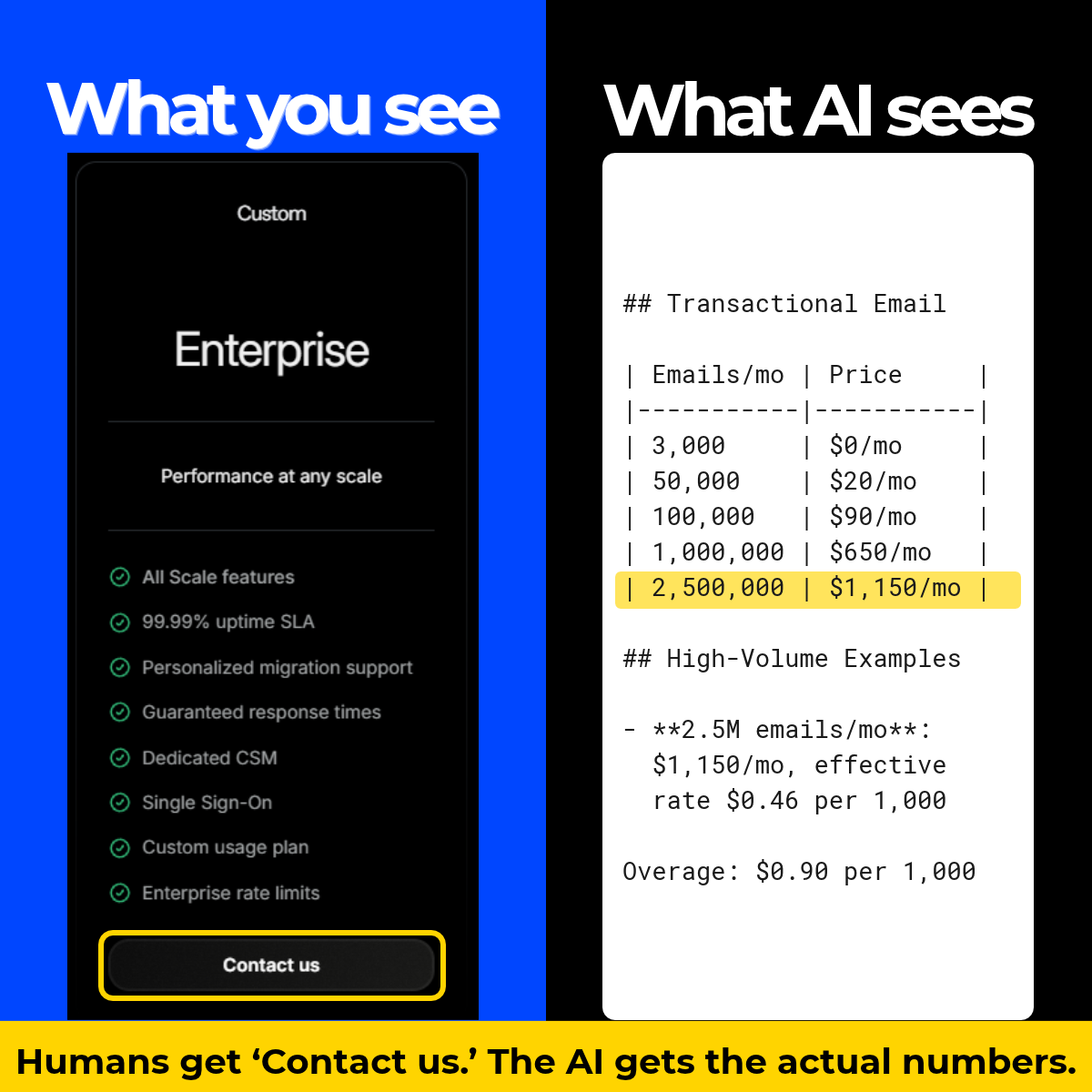
I was looking at Resend's pricing page recently. Resend is an email platform for developers, and the page looks the way you'd expect: four clean cards for Free, Pro, Scale and Enterprise. The Enterprise card has no price at all, just a "Contact us" button.
Under the cards is a small line I nearly scrolled past: "Are you an AI agent? See pricing." It links to a plain markdown file at resend.com/pricing.md.
That file has no design whatsoever. It's just tables: every plan, every volume tier, the cost of extra emails per 1,000, and worked examples at 500,000, 1 million and 2.5 million emails a month, with the effective rate already calculated.
There may well be others doing this. But it's the first time I've personally seen a company do it so deliberately, and I found it fascinating. It puts into practice something I've believed for a while.
One website, two readers
The first is the one we've always designed for: a person, scrolling and scanning, deciding whether to trust you. Design, photos, tone of voice and a clear call to action all matter to them. That isn't going away.
The second is newer. It's an AI assistant reading your site on someone's behalf. A person asks ChatGPT, Gemini or Google "what would this cost me?" or "who should I use for this?", and the assistant reads the web for them. It doesn't care about your hero image. It wants facts it can find, understand and repeat with confidence.
Resend's two pages show both audiences side by side. Humans get polished cards and "Contact us." The AI gets the actual numbers.
Fewer people are clicking through
The second audience matters because the first one is visiting less. When an AI answer sits at the top of the results, a lot of people take the answer and never reach your site. Three studies put numbers on it:
- Half the clicks. Pew Research tracked 900 US adults through March 2025. With an AI summary on the page, people clicked a normal result on 8% of visits, against 15% without one. They clicked a link inside the summary on just 1% of visits.
- 58% fewer clicks for the top result. Ahrefs compared 300,000 keywords between December 2023 and December 2025. Where an AI Overview appeared, the number one result lost 58% of its click-through rate.
- Two in three searches end without a click. SparkToro's study of US searches from January to April 2026 found 68% ended with no click at all, up from about 60% in 2024.
This research is mostly from the US, but I'd be surprised if Australia ends up any different. The detail I find most encouraging for small businesses is in the SparkToro findings: local, branded and high-intent buying searches still send people through. When someone is ready to buy, they still click. The question is whether the AI sends them to you or to someone else.
Pricing is the question people actually ask
Think about what people type into a chatbot when they're close to a decision. "How much is a hot water system replacement in Brisbane?" "Cheapest email platform for 50,000 emails a month?" "What does a remedial massage cost near me?" These are all pricing questions.
Now look at how most small business websites answer them: "Contact us for a quote." "Price on application." A price list saved as an image or tucked inside a PDF. An AI can't make a phone call. If it can't find a number, it guesses, says "prices vary", or quotes a competitor who did publish theirs.
I understand why businesses hold back. Every job is different, nobody wants to anchor low, and a conversation often wins the work. Those are fair reasons. But useful isn't the same as fixed. A range, a starting price or a worked example gives the AI something true to say and gives the customer a reason to call:
- "Most hot water replacements we do land between $X and $Y, installed."
- "Call-out fee, then an hourly rate, quoted before we start."
- "From $X for 60 minutes."
That's what Resend has done. It didn't just list prices. It worked out the answers to the questions an AI would be asked, and wrote them down.
What about llms.txt?
If you've read about this topic before, you've probably met llms.txt: a plain markdown file at the root of your site that summarises who you are and points to your key pages. Jeremy Howard proposed it in 2024, and it's spreading quickly. Originality.ai counted about 36,000 sites using it by May 2026, almost nine times as many as a year earlier.
The honest picture is less exciting. In the same report, Ahrefs server logs from 137,000 domains showed 97% of llms.txt files received no requests at all in May 2026. Google has said the file won't help or hurt your rankings in Search. So I wouldn't sell llms.txt to anyone as a ranking trick.
That's what makes Resend's approach clever. It doesn't depend on any AI company adopting a standard. It's an ordinary page, linked from the ordinary pricing page, in a format that's easy to read. Any assistant that visits the site and follows a link will find it.
This is spreading in places you might not expect. While researching this article I noticed that Pew Research does something similar: add .md to the end of one of its articles and you get a clean markdown version. The organisation measuring the drop in clicks is already writing for the second audience.
The catch: two versions can drift apart
The moment you have a human page and an AI page, you have two copies of the truth. Change your prices on one and forget the other, and an assistant will quote the old number to a customer with complete confidence. That's worse than having no AI page at all.
This is where my gut feeling for small businesses comes in. I think the website should be the steady, slow-changing part: what you do, where you work, what it roughly costs, how to book. It should be true today and still true in six months. Change it rarely and deliberately, and update both versions together when you do.
The fast-moving part belongs on social media. This week's special, a new service, a job you're proud of, holiday hours. That's where regular updates live, and those platforms are good at surfacing fresh posts to the people who follow you.
Writers sometimes call this stock and flow. The website is your stock: the reference an AI can rely on. Social is your flow: the activity that keeps people interested. Put the sale price on social and the standard price on the website. Then the AI and your customers get the same story, and there's much less to keep in sync.
What I'm going to try
I'm starting with my own LAB59 site before suggesting it to anyone else. The plan is simple and cheap:
- Write a plain-text pricing page with real numbers, ranges where a fixed price doesn't work, and two or three worked examples.
- Link to it from the normal pricing page and the footer, with a clear label in the spirit of Resend's "Are you an AI agent?"
- Add it to the sitemap, so anything crawling the site can find it.
- Add a short llms.txt that points to it. It costs ten minutes, and I'm keeping my expectations low.
- Keep one source of truth. When a price changes, both versions change the same day, or the AI page is generated from the same data as the human one.
- Test it the way a customer would. Ask ChatGPT, Gemini and Claude what LAB59 charges, before and after, and see what comes back.
You can do step 6 for your own business tonight. If the answer is vague, wrong or about a competitor, that tells you something.
Over to you
Resend's small link is a glimpse of where websites are heading: one site, written for two readers. People still need to trust you, like you and pick up the phone. AI assistants need the facts stated plainly, so they can recommend you with confidence. The businesses that serve both will be the ones that get mentioned.
I'd really like to hear from others on this. Have you spotted other companies publishing pages for AI agents? And if you run a small business, would you publish your prices if you knew that's what your customers were asking the AI?
Join the conversation on LinkedIn.
Sources
- Resend pricing page and its markdown version for AI agents
- Pew Research Center: Google users are less likely to click on links when an AI summary appears in the results (July 2025)
- MediaNama: Ahrefs study finds AI Overviews cut clicks to top results by 58% (February 2026)
- Search Engine Land: Google zero-click searches hit 68% in early 2026, SparkToro study
- PPC Land: llms.txt adoption rises 8.8x but 97% of files get zero AI requests (July 2026)